Twenty-five years ago in wholesale telecoms, we could already see voice prices falling towards zero. Voice wouldn’t disappear, but it would stop being the product and become a feature bundled into the data services around it.
That was one reason I moved from wholesale voice at Energis into wholesale data at Cable & Wireless. The other, rather less strategic reason, was redundancy.
Either way, the value was moving.
Telecoms was full of dividing lines then. Voice people and data people. Mobile and fixed. Dial-up internet giving way to always-on broadband and IP networks. Then the OTT players arrived, threatening to disintermediate the operators altogether.
Some of that disintermediation happened. WhatsApp, Teams, FaceTime and countless other applications took services operators once charged handsomely for and made them features running over somebody else’s network.
BUT telecoms companies are still here and networks still matter. The industry remains full of opportunity and enormous amounts of capital continue to flow into it.
Summary - Does the market understand what your business is becoming? Telecoms has reinvented itself before, and the value is moving again. AI is making digital infrastructure more physical, driving investment into fibre, subsea, data centres, power and cooling. As connectivity continues to become ever more strategically important, selling connectivity risks commoditisation. Don’t create a communications debt which happens when your company’s strategy and operations evolve faster than the story it tells about itself.
What changed was where the value sits. Looking at Capacity Europe this year, I wonder if we are watching it happen again. Capacity started 25 years ago as a wholesale telecoms gathering. The 2026 agenda has an AI Build Stage, a Fibre Investment Stage and a Digital Infrastructure Finance & Investment Summit but the boundaries between these industries are becoming increasingly difficult to draw.
Hyperscalers can be customers, competitors and partners to telecoms companies at the same time. Data centres need fibre. Fibre networks connect data centres. Both need power. Subsea cables need terrestrial networks at either end. Even satellites need ground segments. None of it works on its own.
For all the excitement around Starlink, SpaceX and LEO satellites, the internet remains surprisingly physical. More than 99% of international data traffic still travels through submarine cables. The ITU estimates that annual investment in those systems rose from $0.8bn in 2015 to $9.7bn in 2025, with hyperscalers increasingly financing the infrastructure themselves. The pipes, quite literally, are still under the sea.
And investment in them is accelerating. In September, EXA announced Meridian, a new 6,552km transatlantic cable between New Jersey and the UK with 24 fibre pairs and more than 500Tbps of capacity. EXA explicitly links the investment to the growth of AI, cloud and distributed data centres, while noting that the largest capacity buyers are increasingly buying complete fibre pairs rather than individual wavelengths.
Perhaps the most interesting thing about the AI revolution is how physical it is becoming. We naturally think of AI as software because that is how we experience it. We type something into a screen and an answer appears. The extraordinary industrial machinery behind that answer remains largely invisible.
But AI can increasingly write its own software. What it can’t create for itself is electricity, processors, cooling, buildings or fibre. The industrial story of AI is increasingly about power, silicon, cooling and connectivity. That physicality is now reshaping where capital goes.
Earlier this month, Equinix and CPP Investments completed their acquisition of Nordic data-centre operator atNorth, a transaction valued at $4bn when it was announced. The rationale included access to high-density capacity capable of supporting enterprise, AI and hyperscale demand. And Google has committed €13bn to digital infrastructure and clean energy in Finland over the next two years. As part of that programme, it has signed a 22-year agreement supporting the extension of the Loviisa nuclear power plant. It is also backing advanced small modular nuclear reactors in the US. Microsoft, has supported the restart of the former Three Mile Island Unit 1 to help meet its data-centre power requirements.
Computing is having to change. NVIDIA’s latest systems are increasingly being designed around dense, liquid-cooled infrastructure and dramatic improvements in computing efficiency because the next generation of AI cannot be delivered by consuming proportionately more electricity.
Across EMEA, operational data-centre capacity has now passed 12.1GW, with another 18.3GW under construction or planned. Increasingly, power availability, grid connections, land and planning rather than demand are determining where that capacity can actually be built. It’s just impossible to continue to scale what we have today indefinitely. That’s the beautiful constraint (NB - read Adam Morgan & Mark Barden) will create another spike in innovation: more efficient processors, better cooling, new forms of power generation and storage, smarter grids and higher-capacity networks. Sustainability will stop being something added to the technology story in the ESG section of the annual report. Efficiency will increasingly be part of the technology itself.
Which creates an interesting paradox for telecoms. Your network is more strategically important than ever, but connectivity alone is easier to treat as a commodity.
We’re no longer simply selling calls, circuits or data plans. We are part of the critical infrastructure on which global commerce, financial markets, cloud computing and AI depend. But describe yourself merely as the connectivity provider and you risk becoming the “dumb pipe” that telecoms companies have spent decades trying to escape. Essential, yes, but with somebody else controlling the customer relationship, the applications and increasingly the margin.
The temptation is to respond by adding more technology to the marketing, more acronyms. That misses the point because enterprise technology decisions are increasingly made by finance, operations, procurement, risk and sustainability as well as technology. The more important the infrastructure becomes, the more people need to understand why it matters.
A changing audience needs an adapted story.
The old claims won’t necessarily survive wider scrutiny. A network might be described as “seamless”, “borderless” and “global”, but international customers know that regulation, infrastructure quality, energy markets and data-sovereignty requirements differ significantly between countries and the same applies to sustainability. Large businesses increasingly need evidence about the carbon embedded in their supply chains. A vague promise of “green connectivity” accompanied by the obligatory photograph of a wind turbine is unlikely to survive serious procurement scrutiny.
The communications challenge therefore grows as the infrastructure becomes more important.
A fibre business starts describing itself as an AI infrastructure company. A data-centre operator becomes one of the largest electricity consumers in a region. A hyperscaler becomes an investor in nuclear power. An acquisition changes the geographic reach and strategic ambition of a company overnight. A telecoms provider moves from selling bandwidth towards providing infrastructure on which customers run mission-critical global operations.
Each change alters the story. It also changes who needs to hear it. Customers, investors, employees, partners, governments, regulators and increasingly the communities living alongside the infrastructure all need to understand what the business is becoming and why it matters to them.
This is where a lot of my own work has ended up over the years: at the point where the business changes faster than the story being told about it.
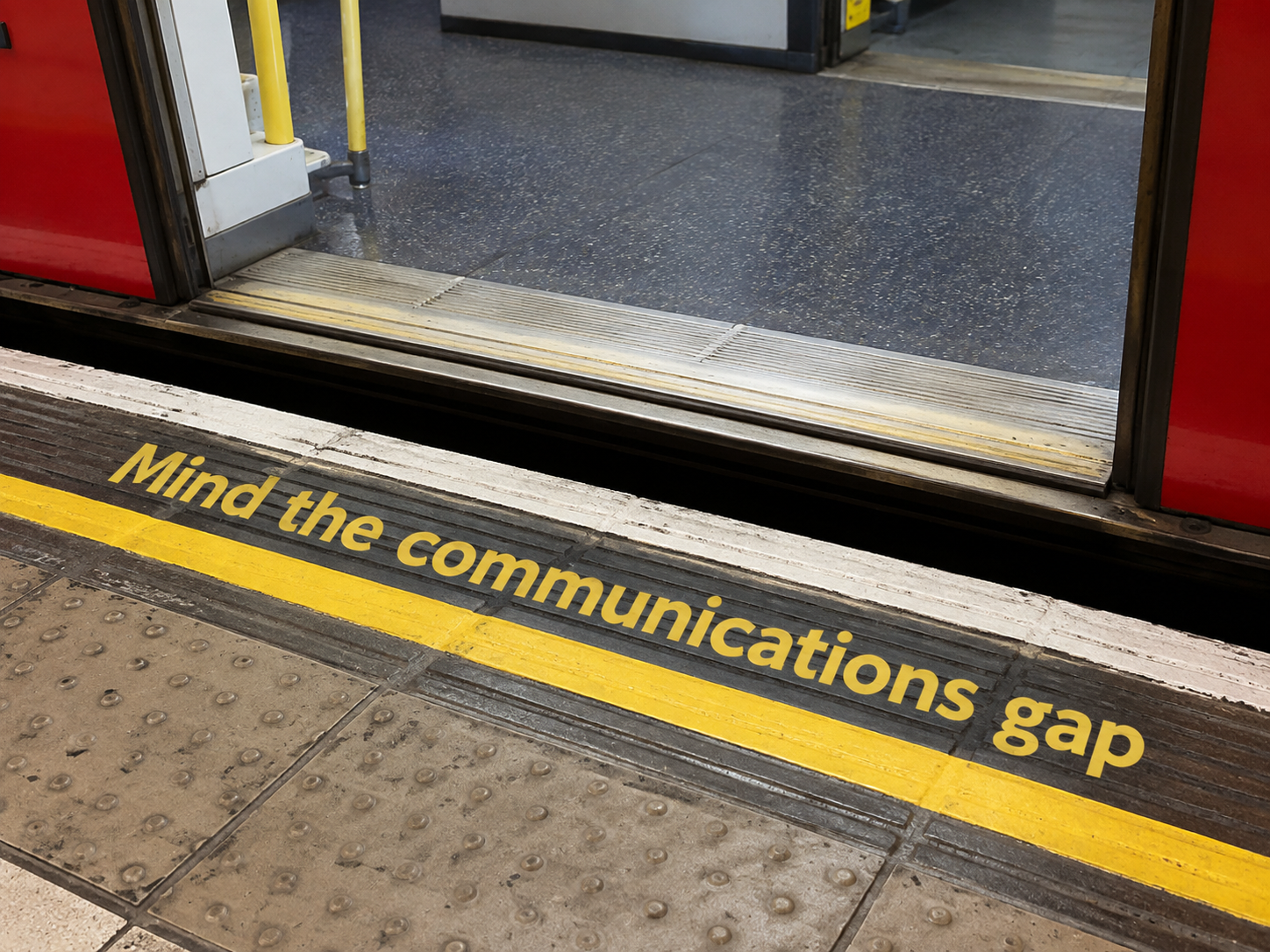
I call the gap that creates **communications debt**: the distance that opens up when a business’s operations and strategy evolve faster than the story it tells about itself.
It accumulates surprisingly easily.
The corporate website is still describing yesterday’s company. Sales is telling one story while investor presentations tell another. Employees cannot clearly explain the new strategy. The business enters a new country and discovers that its reputation did not cross the border with it. Management knows exactly where the company is going but has never quite translated that thinking into something customers and the wider market understand.
None of these problems necessarily appears on the balance sheet. But eventually somebody pays for them.
That is one reason Capacity Europe should be particularly interesting this year. The visible conversations will be about AI, fibre, subsea, data centres, energy, M&A and the extraordinary amount of capital moving into digital infrastructure.
Underneath many of them sits a simpler question.
**As the value moves again, does the market understand what your business is becoming?**
If you are not sure, you may have some communications debt to repay.
I’ll be at Capacity Europe in London in October. If that sounds familiar, come and find me.